
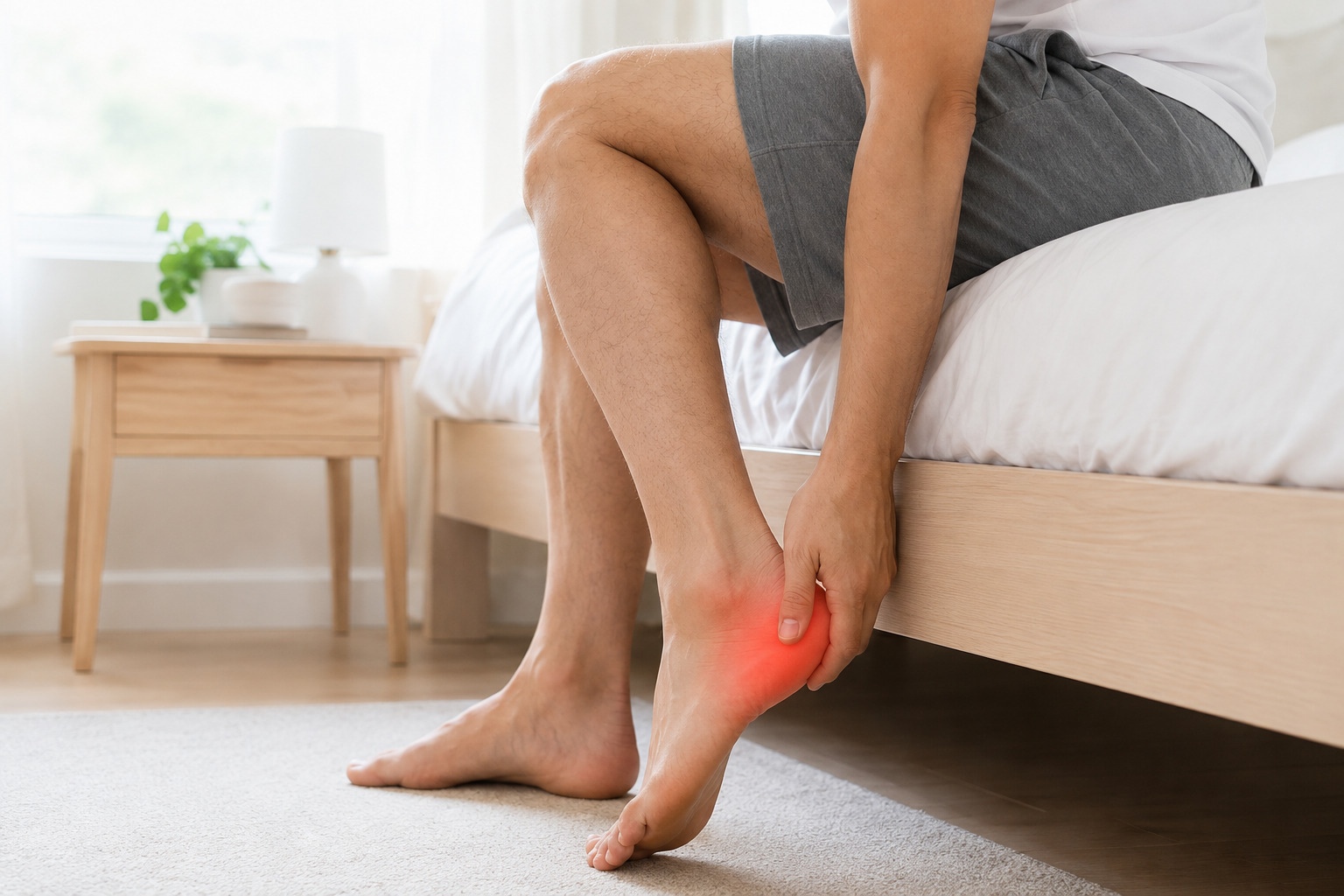
That sharp, stabbing pain in your heel the moment you take your first step out of bed catches many people off guard. Plantar fasciitis is one of the most common foot complaints seen in orthopaedic practice in Singapore, affecting everyone from office workers to recreational runners.
Understanding Morning Heel Pain and Plantar Fasciitis
You wake up, swing your legs over the side of the bed, and the moment your foot touches the floor, a sharp pain shoots through your heel. It can ease after a few minutes of walking, only to return after sitting for a while.
This pattern is a hallmark of plantar fasciitis. Many patients recover with the right approach.
What Is Plantar Fasciitis?
Plantar fasciitis is inflammation of the plantar fascia, the thick band of tissue that runs along the sole of your foot, connecting your heel bone to the base of your toes. “Fasciitis” simply means inflammation of the fascia.
When this band is placed under repetitive stress, small micro-tears can develop in the tissue. These micro-tears trigger an inflammatory response (your body’s natural repair mechanism), causing pain and stiffness, particularly at the point where the fascia attaches to the heel bone.
Think of the plantar fascia like a bowstring stretched along the underside of your foot. Every step you take loads that string. If the load exceeds what the tissue can handle, whether through a sudden increase in activity, prolonged standing, or structural factors, the fibres begin to fray at their weakest point.
Plantar fasciitis is common among runners and sports enthusiasts, but it is equally seen in those who spend long hours on their feet at work, or those who have recently increased their activity levels after a sedentary period. It is a condition that crosses all ages and fitness levels.
Why Does Plantar Fasciitis Cause Heel Pain in the Morning?
When you are at rest, the plantar fascia naturally shortens and contracts. The longer you rest, the tighter the tissue becomes.
The moment you stand up and place weight on your foot, that contracted tissue is suddenly stretched and loaded all at once. This abrupt tension on already-irritated fibres produces that sharp, first-step pain.
As you walk around and the tissue warms up and loosens, the pain often eases. Many people describe the pain as worst first thing in the morning or after sitting for an extended period, then improving after a few minutes of movement. After prolonged activity, the pain can return as the tissue fatigues again.
This cycle of pain, relief with movement, and return after rest is one of the clearer indicators that plantar fasciitis may be the cause of your heel discomfort.
Common Causes and Risk Factors
Plantar fasciitis typically develops when a combination of factors places more load on the plantar fascia than it can comfortably handle.
Lifestyle and Occupational Factors
- Prolonged standing or walking: Jobs that require long hours on hard floors, such as healthcare, retail, or food service, place continuous load on the tissue.
- Flat, unsupportive footwear: In Singapore’s warm climate, slippers and flat sandals are popular choices, but they offer minimal arch support and cushioning, which can increase stress on the plantar fascia over time.
- Sudden weight changes: An increase in body weight raises the load on the foot’s soft tissues with every step.
- Hard flooring surfaces: Tile and concrete floors, common in Singapore homes and workplaces, offer little shock absorption compared to softer surfaces.
Foot Structure and Biomechanics
- Flat feet (low arches): When the arch collapses with each step, the plantar fascia is stretched further than it is designed to handle.
- High arches: A rigid, high-arched foot distributes load unevenly, concentrating stress on the heel and ball of the foot.
- Tight calf muscles and Achilles tendon: When the calf muscles (the muscles at the back of your lower leg) are tight, they pull on the heel bone and increase tension in the plantar fascia.
- Overpronation: This is the tendency of the foot to roll inward excessively with each step, placing uneven stress on the fascia.
Sports and Training-Related Triggers
- Running and high-impact sports: Repetitive loading from running, football, basketball, and similar activities can overload the plantar fascia, especially on hard surfaces.
- Sudden increases in training volume: Ramping up your mileage or training intensity too quickly may not give the tissue adequate time to adapt.
- Inadequate warm-up or cool-down: Skipping stretching before and after exercise keeps the calf muscles and plantar fascia tight and may increase vulnerability to injury.
- Worn-out training shoes: Shoes that have lost their cushioning and support may no longer protect the foot adequately.
How Is Plantar Fasciitis Diagnosed in Singapore?
Diagnosis is usually straightforward and does not require complex investigations. An orthopaedic specialist will begin with a detailed clinical history, asking about the nature and timing of your pain, your activity levels, footwear habits, and how long symptoms have been present.
A physical examination follows, with the doctor assessing tenderness at the medial calcaneal tubercle (the bony point on the inner side of your heel where the plantar fascia attaches). Reproducing your pain with gentle pressure at this specific point is a useful diagnostic indicator.
Imaging may be recommended in certain situations:
- Ultrasound: This can confirm thickening or tearing of the plantar fascia and is useful when the diagnosis is uncertain or to guide injection treatments.
- X-ray: Occasionally used to identify a heel spur, which is a bony outgrowth on the heel bone. Heel spurs visible on X-ray are not always the source of pain. Many people have heel spurs without any symptoms. The plantar fascia inflammation, rather than the spur itself, is often responsible for the discomfort.
In many cases, a thorough clinical assessment is sufficient to support the diagnosis and begin treatment.
Plantar Fasciitis Treatment Options
Treatment for plantar fasciitis is stepwise, starting with the least invasive approaches and progressing only if symptoms do not improve adequately. Many cases respond to conservative, non-surgical care.
The table below summarises the main treatment approaches, what each involves, the typical timeline for improvement, and who each option may suit best.
| Treatment Type | What It Involves | Typical Timeline for Improvement | Who It May Suit Best |
|---|---|---|---|
| Rest and stretching | Reducing aggravating activities; daily calf and plantar fascia stretches | 4-8 weeks with consistent effort | Most patients as a first-line approach |
| Footwear modification | Switching to supportive shoes; avoiding flat slippers and hard-soled footwear | Improvement alongside other measures | Anyone whose footwear may be contributing |
| Physiotherapy | Guided stretching, strengthening, manual therapy, and gait assessment | 6-12 weeks | Patients with biomechanical contributors or persistent symptoms |
| Orthotics | Custom or off-the-shelf insoles to support the arch and reduce fascial strain | Improvement alongside other measures | Those with flat feet, high arches, or overpronation |
| Shockwave therapy | Non-invasive sound wave treatment to stimulate tissue healing | 3-6 sessions over several weeks | Patients with symptoms lasting 3 months or more |
| Corticosteroid injection | Anti-inflammatory injection into the affected area | Days to weeks for pain relief | Short-term relief when pain is severe; used selectively |
| Surgery | Partial release of the plantar fascia; rarely required | Several months of recovery | Cases that have not responded to 6-12 months of conservative treatment |
Stretching, Rest, and Footwear Modifications
The foundation of plantar fasciitis treatment is a consistent stretching routine combined with sensible footwear choices. Stretching the calf muscles and the plantar fascia may reduce tension on the heel attachment and support tissue healing.
Key stretches include:
- Plantar fascia stretch: While seated, cross one foot over the opposite knee and gently pull the toes back toward the shin. Hold for 20-30 seconds and repeat several times.
- Calf stretch: Stand facing a wall with one foot forward and one foot back. Keep the back heel flat on the floor and lean into the wall to stretch the calf. Hold for 30 seconds on each side.
Performing these stretches before taking your first steps in the morning may be helpful for many people. You may wish to discuss a stretching routine with your healthcare professional to confirm it is appropriate for your situation.
Supportive shoes with good arch support and cushioned soles may help reduce the load on the plantar fascia. In Singapore’s climate, replacing flat slippers with sandals that offer arch support and cushioning can be a practical change worth considering.
Physiotherapy and Orthotics
A physiotherapist can assess the way you walk and move, identify contributing biomechanical factors, and guide you through a structured rehabilitation programme. This typically includes strengthening the foot and calf muscles, improving flexibility, and addressing any gait abnormalities.
Custom or prefabricated orthotics (supportive insoles placed inside your shoes) may help correct foot alignment and reduce strain on the plantar fascia. They are often considered for those with flat feet, high arches, or overpronation.
Shockwave Therapy and Injection Treatments
For cases that persist beyond three months despite consistent conservative care shockwave therapy may be considered. This non-invasive treatment delivers targeted sound waves to the affected tissue, with the aim of stimulating the body’s healing response and reducing chronic inflammation.
Corticosteroid injections (anti-inflammatory medication injected directly into the painful area) may provide short-term pain relief, particularly when symptoms are severe. They are used selectively, as repeated injections carry a small risk of weakening the plantar fascia over time.
When Surgery May Be Considered
Surgery for plantar fasciitis is uncommon. It is generally considered only when symptoms have persisted for six to twelve months despite thorough conservative treatment. The procedure typically involves a partial release of the plantar fascia to reduce tension at the heel attachment. Recovery takes several months, and the decision to proceed is made carefully on an individual basis.
How Long Does Plantar Fasciitis Take to Heal?
Many people with plantar fasciitis see meaningful improvement within six to twelve months with consistent conservative treatment. Some experience relief sooner, particularly when they begin stretching early and address contributing factors like footwear and activity levels. Recovery time varies by individual.
Recovery time is influenced by several factors:
- How long symptoms have been present: Earlier intervention may support faster recovery.
- Consistency with stretching: Daily stretching may make a meaningful difference. Sporadic effort tends to produce slower results.
- Activity modification: Continuing high-impact activities without modification can slow healing.
- Individual factors: Foot structure, overall health, and adherence to the treatment plan all play a role.
Progress is often measured in weeks and months, not days. Staying consistent with your rehabilitation, even on days when the pain feels manageable, is important for recovery.
Three Daily Habits That May Support Recovery
- Stretch before your first step: Performing calf and plantar fascia stretches while still in bed, before placing weight on your foot, may help reduce first-step pain.
- Choose supportive footwear every day: Avoiding flat slippers around the house and wearing shoes or sandals with arch support and cushioning from the moment you get up may help reduce strain on the plantar fascia.
- Gradually ease back into activity: Avoiding sudden spikes in walking, running, or standing duration and increasing activity levels incrementally may allow the tissue to adapt more comfortably.
Returning to Exercise and Sports After Plantar Fasciitis
Returning to running, gym training, or competitive sport after plantar fasciitis is a realistic goal for many people. A graduated return to activity means progressively increasing the load on the plantar fascia over time, giving the tissue a chance to adapt and strengthen. Returning to your previous training volume too quickly is one of the more common reasons for setbacks.
During recovery, consider cross-training alternatives that maintain your fitness while reducing impact on the heel:
- Swimming: Cardiovascular conditioning with no impact load on the foot.
- Cycling: Low-impact and useful for maintaining leg strength and aerobic fitness.
- Pool running: Allows you to maintain running mechanics without ground impact.
Signs that you may be ready to return to higher-impact activities include:
- No pain during normal daily walking
- Minimal or no discomfort with gentle jogging on a soft surface
- Consistent improvement in morning stiffness over several weeks
If pain returns when you increase your activity, scaling back and allowing more recovery time before trying again may be helpful. Working with a physiotherapist to structure your return-to-sport plan may reduce the risk of re-injury.
When to Seek Professional Help
- Heel pain has persisted for more than two to four weeks despite rest, stretching, and footwear changes
- Pain is worsening rather than gradually improving
- You are unable to bear weight comfortably on the affected foot
- Heel pain is significantly affecting your ability to walk, work, or participate in daily activities
- You are an athlete and pain is preventing you from training or competing
- You have tried conservative measures consistently but are not seeing progress
Seeking evaluation early, rather than waiting for symptoms to become severe, may support simpler treatment and more straightforward recovery.
Commonly Asked Questions
Can plantar fasciitis go away on its own without treatment?
Mild cases of plantar fasciitis can improve over time with rest alone, but recovery without any active management is typically slower and less predictable. Consistent stretching, footwear changes, and activity modification may improve outcomes. Ignoring persistent symptoms and continuing aggravating activities can allow the condition to become more chronic and harder to treat.
Is plantar fasciitis more common in runners?
Runners are at higher risk due to the repetitive impact loading involved, but plantar fasciitis is by no means exclusive to runners. It is common among people who stand for long hours, those who have recently increased their activity levels, and individuals with certain foot structures.
Are heel spurs the same as plantar fasciitis?
No. A heel spur is a bony outgrowth on the heel bone that may appear on an X-ray. Plantar fasciitis refers to inflammation of the plantar fascia tissue. The two can occur together, but many people have heel spurs without any pain, and many people with plantar fasciitis do not have heel spurs. The tissue inflammation, rather than the bony spur, is typically the source of the pain.
Should I avoid walking if I have plantar fasciitis?
Complete rest is generally not necessary and is not always recommended. Moderate walking is usually fine and may help maintain tissue mobility. Avoiding prolonged walking on hard surfaces, walking barefoot, or sudden increases in walking duration that overload the tissue may be helpful. Wearing supportive footwear and pacing your activity are generally considered more important than stopping movement entirely. You may wish to discuss activity modification with your healthcare professional.
What type of shoes are best for plantar fasciitis in Singapore’s climate?
Shoes or sandals with good arch support, a cushioned midsole, and a slight heel elevation (not completely flat) are generally worth considering. In Singapore’s warm climate, supportive sandals with contoured footbeds may be a practical option for everyday wear. Flat flip-flops, hard-soled shoes, and walking barefoot on hard floors, particularly first thing in the morning, are generally best avoided. A healthcare professional can provide guidance on footwear suited to your specific foot structure.
Next Steps for Managing Your Heel Pain
You may wish to begin with daily calf and plantar fascia stretches, review your footwear choices, and moderate any activities that are aggravating your symptoms.
Monitor your progress over the next two to four weeks. Many people notice improvement with these foundational steps. If your pain is not responding, is worsening, or is limiting your daily function or training, arranging a specialist assessment may be a sensible next step.
Disclaimer: This article is for informational purposes only and does not constitute medical advice. Please consult a qualified healthcare professional for personalised guidance.
Speak with an Orthopaedic Specialist About Your Heel Pain
If conservative measures have not provided adequate relief, or if you are unsure whether your heel pain is plantar fasciitis, a consultation with an orthopaedic specialist may help provide clarity. An accurate diagnosis and a structured plantar fasciitis treatment plan tailored to your needs are the foundation of effective recovery, supporting your return to daily activities and the things you enjoy.