Being sidelined by a sports injury is frustrating, whether you are a competitive athlete, a weekend runner, or someone who simply enjoys staying active. With the right approach to sports injuries treatment in Singapore, many people can return to the activities they love.
Understanding Sports Injuries
Singapore has an active sporting culture. From the Standard Chartered Marathon to recreational football leagues, padel courts, and gym communities, movement is woven into daily life for many people here. When an injury interrupts that, the impact goes beyond physical pain. It affects routine, mood, and identity.
Injuries that are managed well from the outset may heal more completely, with a potentially lower risk of re-injury. A clear plan, guided by accurate diagnosis, is an important foundation for recovery.
What Counts as a Sports Injury?
A sports injury is any damage to muscles, tendons, ligaments, bones, or joints that occurs as a result of physical activity, whether during sport, exercise, or active recreation. These injuries range from mild soft tissue strains to complete ligament tears or fractures, and they affect not just competitive athletes but anyone who moves regularly, including gym-goers, weekend warriors, and people who simply enjoy an active lifestyle. Sports injuries generally fall into two broad categories.
Acute Injuries
Acute injuries happen suddenly, usually as the result of a specific incident. A twisted ankle during a football match, a fall onto an outstretched hand, or a sharp pop in the knee during a pivot are all examples. The onset of pain, swelling, or instability is immediate and clearly linked to a single moment.
Common acute injuries include:
- Ligament sprains (stretched or torn ligaments)
- Muscle or tendon strains (overstretched or torn muscle fibres or tendons)
- Fractures and dislocations
- Acute rotator cuff tears (tears in the shoulder-stabilising muscles)
Overuse Injuries
Overuse injuries develop gradually over time. There is no single dramatic incident. Instead, repetitive stress on a tissue accumulates faster than the body can repair it. Runners who increase their mileage too quickly, or tennis players who practise their serve for hours without adequate recovery, are both at risk.
Common overuse injuries include:
- Tendinopathy (tendon degeneration from repetitive loading)
- Stress fractures
- Patellofemoral pain syndrome (runner’s knee, where the kneecap does not track correctly)
- Shoulder impingement (pinching of soft tissue in the shoulder joint)
Common Sports Injuries Seen in Singapore
Singapore’s sporting landscape shapes the types of injuries that present most frequently. Running on hard road and track surfaces, racquet sports such as tennis, badminton, and the rapidly growing padel scene, football, and gym-based training all place distinct demands on the body. The heat and humidity here also affect how athletes train and recover, which can contribute to fatigue-related errors in technique.
Shoulder Injuries
The shoulder is one of the most mobile joints in the body, which also makes it one of the more vulnerable. Injuries here are particularly common in overhead and throwing sports.
Frequently seen shoulder injuries include:
- Rotator cuff tears: The rotator cuff is the group of four muscles and their tendons that hold the shoulder joint stable. Tears can occur acutely or develop gradually through overuse.
- Shoulder impingement: Soft tissue in the shoulder becomes pinched during overhead movement, causing pain and restricted range of motion.
- Labral tears: The labrum is the ring of cartilage that deepens the shoulder socket. Tears often occur in throwing athletes or after a dislocation.
- Shoulder dislocation and instability: Common in contact sports and falls, and can lead to recurrent instability if not treated appropriately.
Knee Injuries
Knee injuries are among the more common presentations in sports orthopaedics, affecting runners, footballers, and gym athletes alike.
Frequently seen knee injuries include:
- Anterior cruciate ligament (ACL) tears: The ACL is one of the key stabilising ligaments of the knee. Tears typically occur during sudden changes in direction or landing from a jump.
- Meniscus tears: The menisci are two C-shaped cartilage pads that act as shock absorbers in the knee. They can tear acutely or wear down over time.
- Patellofemoral pain syndrome: Pain around or behind the kneecap, often associated with running or squatting.
- Patellar tendinopathy: Degeneration of the tendon connecting the kneecap to the shin bone, common in jumping sports.
Ankle and Lower Limb Injuries
- Ankle sprains: Among the more frequent sports injuries overall, involving stretched or torn ligaments on the outer ankle.
- Achilles tendon injuries: Ranging from tendinopathy to complete rupture, these affect runners and court sport athletes.
- Shin splints: Pain along the inner shin, typically from overuse or a sudden increase in training load.
- Stress fractures: Small cracks in bone caused by repetitive impact, often seen in distance runners.
When Is a “Minor” Injury Worth Assessing?
Not every significant injury announces itself dramatically. Pain that lingers beyond a week, swelling that subsides but keeps returning, or a joint that feels subtly unstable during activity may all point to underlying structural damage. Tendons, ligaments, and cartilage do not always cause severe pain even when significantly injured. If something does not feel right, or if a recurring issue keeps interrupting your training, it may be worth having it assessed by a healthcare professional.
How Are Sports Injuries Diagnosed?
Sports injuries are diagnosed through a combination of clinical examination and targeted imaging, with the specific approach depending on the injury type, location, and how long symptoms have been present. Accurate diagnosis is the foundation of an effective treatment plan; addressing the wrong problem, or the right problem incorrectly, can delay recovery and increase re-injury risk.
Physical Examination and Clinical Assessment
A thorough physical examination is usually the starting point. Your doctor will ask about how and when the injury occurred, what makes it better or worse, and how it is affecting your activity. They will then assess the injured area directly, looking at range of motion, strength, stability, and specific pain patterns.
Targeted clinical tests help identify which structures are involved. For example, specific manoeuvres can indicate whether a knee ligament is intact or whether a shoulder’s rotator cuff is functioning normally.
Imaging and Advanced Diagnostics
Imaging provides a clearer picture of the internal structures.
- X-rays are useful for identifying fractures, joint alignment issues, and bony changes.
- MRI (magnetic resonance imaging) provides detailed images of soft tissues, including ligaments, tendons, cartilage, and muscles. It is particularly valuable for assessing ACL tears, meniscal damage, and rotator cuff injuries.
- Ultrasound allows real-time assessment of tendons and soft tissues and is useful for guiding injections.
In some cases, arthroscopy (keyhole joint surgery, where a small camera is inserted into the joint through tiny incisions) serves as both a diagnostic and treatment tool. When imaging findings are inconclusive but symptoms are significant, arthroscopy allows direct visualisation of the joint’s interior.
From Rest to Rehabilitation: The Stages of Sports Injury Treatment
Treatment for a sports injury varies depending on the type of injury, its severity, and the individual’s activity goals. The table below provides a broad overview of the treatment continuum.
| Stage | What It Involves | Typical Injuries | Approximate Timeline |
|---|---|---|---|
| Immediate management | PRICE protocol (Protection, Rest, Ice, Compression, Elevation), pain relief, offloading | Acute sprains, muscle strains, minor fractures | Days 1 to 7 |
| Conservative treatment | Physiotherapy, bracing, activity modification, targeted exercises | Mild to moderate ligament sprains, tendinopathy, overuse injuries | Weeks to months |
| Surgical treatment | Arthroscopic or open repair, reconstruction, joint preservation procedures | Complete ligament tears, significant rotator cuff tears, cartilage damage | Variable; followed by structured rehabilitation |
Immediate Management and Protection
In the first hours and days after an acute injury, the priority is to limit further damage and manage the initial inflammatory response.
The PRICE protocol is a practical first-response framework:
- Protection: Avoid placing full weight or strain on the injured joint to prevent further damage.
- Rest: Reduce or stop the activity that caused the injury.
- Ice: Apply ice wrapped in a cloth to the injured area for 15 to 20 minutes at a time to help reduce swelling.
- Compression: Use a bandage or compression wrap to support the injured area.
- Elevation: Raise the injured limb above heart level where possible to help reduce fluid accumulation.
Over-the-counter pain relief and anti-inflammatory medication may also help manage early symptoms. This phase is about protection and creating the right conditions for healing to begin.
Conservative Treatment and Physiotherapy
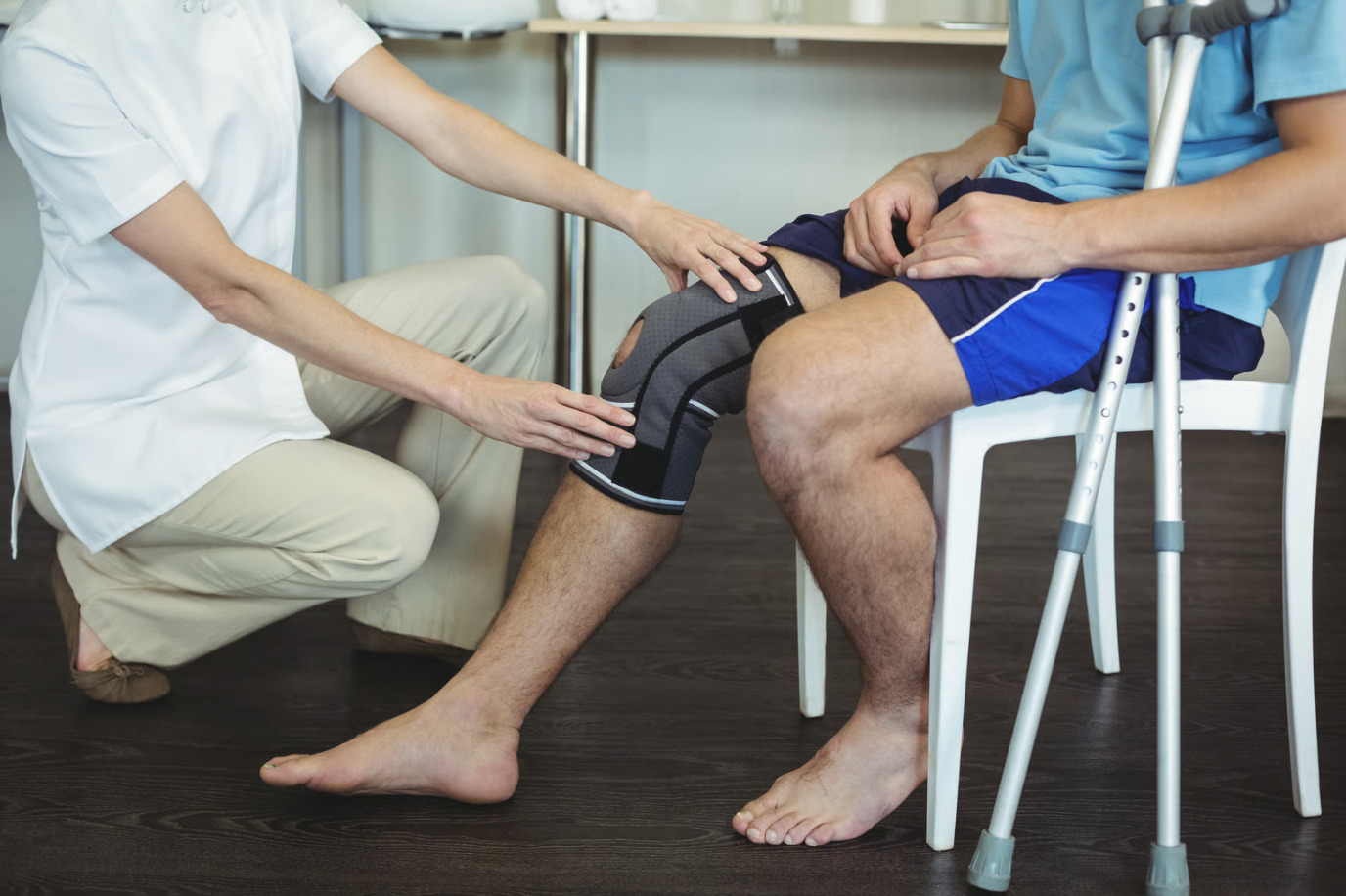
For many sports injuries, structured conservative treatment is a primary pathway to recovery. This phase typically involves:
- Physiotherapy: A progressive programme of stretching, strengthening, and neuromuscular retraining (retraining the nervous system and muscles to work together correctly) tailored to the specific injury.
- Bracing and taping: Providing external support to an injured joint while it heals and while strength is being rebuilt.
- Activity modification: Adjusting training load, intensity, or movement patterns to allow healing without complete deconditioning.
- Injection therapies: In selected cases, corticosteroid or platelet-rich plasma injections may be used to support tissue healing.
The goal is to work towards relieving pain and restoring function, including strength, stability, and movement quality, though outcomes vary by individual.
Surgical Treatment Options
Surgery may be considered when structural damage is significant and conservative management is unlikely to restore adequate function or stability. Surgical repair or reconstruction may give the tissue an opportunity to heal in these circumstances.
Common surgical indications include:
- Complete ACL tears in active individuals
- Full-thickness rotator cuff tears
- Significant meniscal tears not suited to conservative management
- Recurrent shoulder dislocation with labral damage
- Cartilage defects requiring restoration or preservation
A joint preservation approach aims to restore the joint’s natural mechanics, with the clinical goal of reducing the long-term risk of degenerative change. Where possible, the aim is to repair and preserve rather than replace.
What Does Arthroscopic Sports Surgery Involve?
Arthroscopic sports surgery is keyhole joint surgery: a small camera (the arthroscope) and fine surgical instruments are inserted into the joint through two or three tiny incisions, typically less than one centimetre each. The surgeon views the joint’s interior on a screen in real time and performs the necessary repair or reconstruction without opening the joint fully.
Because the incisions are small, arthroscopic surgery is generally associated with:
- Less disruption to surrounding tissue compared to open surgery
- Reduced post-operative pain in many cases
- Shorter hospital stays, often as a day procedure
- Earlier commencement of rehabilitation in many cases
Arthroscopy is used for a range of shoulder and knee conditions, including ACL reconstruction, meniscal repair or trimming, rotator cuff repair, labral repair for shoulder instability, and cartilage procedures. It allows both direct assessment and surgical treatment within the same procedure.
Not every joint condition requires arthroscopy, and your surgeon will discuss whether it is the most appropriate option for your specific injury and goals.
How Long Does Recovery from a Sports Injury Take?
Recovery timelines vary considerably depending on the injury type, its severity, whether surgery was required, and individual factors such as age, baseline fitness, and how consistently rehabilitation is pursued.
The table below provides indicative recovery windows. These are broad ranges only; individual recovery plans should always be guided by a specialist who can assess your progress at each stage.
| Injury Type | Typical Conservative Recovery | Typical Post-Surgical Recovery |
|---|---|---|
| Mild ankle sprain | 1 to 3 weeks | Not usually required |
| Moderate ligament sprain | 4 to 8 weeks | Not usually required |
| Achilles tendinopathy | 3 to 6 months | 4 to 6 months if surgery needed |
| Meniscus tear (partial) | 6 to 12 weeks | 3 to 6 months post-repair |
| ACL tear | Conservative management may not restore full stability in all cases | 9 to 12 months post-reconstruction |
| Rotator cuff tear (partial) | 3 to 6 months | 4 to 6 months post-repair |
| Rotator cuff tear (full-thickness) | Conservative management has limited success in many cases | 6 to 12 months post-repair |
Pain often resolves before tissue has fully healed or strength has been fully restored. Returning too soon is a common contributing factor to re-injury. Structured rehabilitation supports that process, with the aim of ensuring that when you return to sport, your body is adequately prepared.
How to Reduce Your Risk of Sports Injuries
Prevention is not about training less. It is about training with attention to load, technique, and recovery. A few consistent habits may help reduce injury risk and support long-term sporting enjoyment.
- Warm up and cool down properly: A dynamic warm-up (active movements that gradually increase range of motion and heart rate) prepares your body for the demands ahead. A cool-down with gentle stretching supports recovery.
- Progress your training load gradually: Sudden increases in distance, intensity, or volume are a common contributing factor in overuse injuries. A general guideline is to avoid increasing training load by more than ten percent per week, though individual tissue tolerance varies and you should listen to your body.
- Wear appropriate footwear and equipment: Shoes suited to your sport and foot type may make a meaningful difference, particularly for running on Singapore’s hard road and track surfaces.
- Cross-train for balanced conditioning: Supplementing your primary sport with complementary activities (such as swimming or cycling for a runner) can help build overall fitness while reducing repetitive stress on specific tissues.
- Respect the heat and humidity: Training in Singapore’s climate increases the physiological load on your body. Adjusting intensity and recovery accordingly, and staying well hydrated, may help manage this.
- Pay attention to persistent symptoms: Fatigue that does not resolve, recurring niggles, or changes in how a movement feels are all signals worth discussing with a healthcare professional. Early assessment may be beneficial, and speaking with a specialist is worth considering if symptoms persist.
Taking Charge of Your Recovery
Recovery from a sports injury is an active process, not a passive one. Active individuals who engage consistently with their rehabilitation programme, ask questions when uncertain, and avoid returning to full activity before they are clinically ready tend to fare well in the recovery process.
That means attending physiotherapy consistently, completing the full range of prescribed exercises, and working with a specialist who understands both the clinical picture and your personal goals, so that the treatment plan reflects what matters to you.
When to Seek Professional Help
- Pain that persists for more than a few days without clear improvement
- A joint that feels unstable, gives way, or locks during movement
- Inability to bear weight on a limb or fully straighten a joint
- Swelling that returns repeatedly after activity
- A significant reduction in range of motion that is not improving
- A pop, snap, or crack at the time of injury, particularly in the knee or shoulder
- An injury that has not responded to rest and basic self-management
Seeking specialist input early may be a useful step. Accurate diagnosis at the outset can help shape the recovery plan and may support a return to sport.
Commonly Asked Questions
Is it safe to continue exercising with a mild sports injury?
This depends on the injury. Some conditions may allow for modified activity, such as swimming instead of running for a mild ankle sprain, while others may require complete rest to prevent further damage. Continuing to load an injured tissue without understanding what is actually wrong can turn a manageable injury into a more significant one. A clinical assessment can help clarify what activity is appropriate during recovery; you may wish to discuss this with a healthcare professional.
What is the difference between a sprain and a strain?
A sprain involves the ligaments, which are the tough bands of tissue that connect bones to each other at a joint. A strain involves the muscles or tendons, which are the tissues that connect muscles to bones. Both involve stretching or tearing of tissue, but the structures affected are different. Sprains most commonly occur at the ankle, knee, or wrist; strains are more common in the hamstring, calf, or lower back.
Do all sports injuries need surgery?
No. Many sports injuries respond well to conservative treatment, including physiotherapy, activity modification, and time. Surgery may be considered when there is structural damage that is unlikely to heal adequately on its own, or when conservative management has not restored sufficient function for the patient’s activity goals. The decision is based on the specific injury, the individual’s lifestyle, and what is likely to provide the most favourable long-term outcome.
How do I know if my knee pain is serious?
Certain features of knee pain suggest a more significant injury worth investigating. These include a knee that locks or catches during movement, a sensation of the knee giving way, significant swelling that develops within a few hours of injury, an inability to fully straighten or bend the knee, or pain that seems disproportionate to the apparent cause. If any of these are present, a specialist assessment may be advisable. A healthcare professional can help determine the appropriate next steps.
When can I return to sport after surgery?
Return-to-sport decisions are typically based on achieving specific milestones rather than simply the passage of time. These milestones may include restoring adequate strength (often measured as a percentage of the uninjured side), regaining full range of motion, demonstrating joint stability, and completing sport-specific movement assessments. Returning before these benchmarks are met may increase the risk of re-injury. Guided rehabilitation, with regular review by your specialist and physiotherapist, can help ensure that you return at an appropriate time.
Speak with a Sports Injury Specialist in Singapore
If you are managing a sports injury and would like to explore your options, speaking with an orthopaedic specialist experienced in sports surgery and joint preservation may help you understand your diagnosis and develop a treatment plan tailored to your goals and activity level.